Last Updated on September 20, 2026 by adminahb
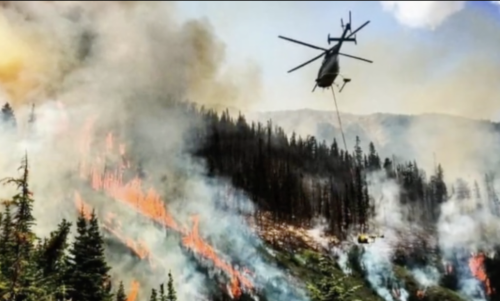
Wildfires in the United States and Canada are not a weather story. They are a budget story, a smoke story, and a land-use story. Suppression is overweighted. Prevention is underfunded. Fine fuels keep stacking in vacant forest. And a slice of the livestock lobby is selling cattle as the only four-legged answer — including on ground where cows cannot live, cannot pay their own keep, and did not stop the last grass fire that ran through cattle country.
The video that goes with this piece shows what the paperwork leaves out: wild horses in wilderness, cutting dry grass and brush that become the ladder and the fuse.
Smoke Is the Killer. The Certificate Says Something Else
Wildfire smoke is fine particulate matter — PM2.5 — small enough to enter the blood. It does not write “smoke” on the death certificate. It writes heart attack, stroke, COPD, dementia, cancer.
A 2025 Nature study led by Stanford’s Marshall Burke estimated more than 41,000 excess U.S. deaths per year from wildfire-smoke PM2.5 in the 2011–2020 baseline, and about 71,000 a year by 2050 under a high-warming path. Cumulative excess deaths from 2026 to 2055 could reach 1.9 million. The authors found the monetized damage from climate-driven smoke deaths can exceed other U.S. climate-damage estimates combined.
A 2026 Science Advances causal study put chronic wildfire-smoke PM2.5 at about 24,100 all-cause U.S. deaths per year for 2006–2020, with no safe threshold.
In California alone, a Science Advances analysis of 2008–2018 fire-sourced PM2.5 attributed 52,480 to 55,710 premature deaths in that state over the period, with economic value in the $430–$456 billion range.
Those papers do not agree on one integer. They agree on the direction: tens of thousands of Americans a year, rising, and the worst years already above 40,000. Children, working adults, and the elderly all breathe the same plume. Canada’s fires load the same air mass onto U.S. cities. This is not a forest-only problem. It is a public-health problem paid in lungs and in Medicaid, Medicare, lost work, and emergency rooms.
Suppression Ate the Forest Service
The U.S. Forest Service itself documented the capture. Fire went from 16 percent of the agency’s appropriated budget in 1995 to more than 50 percent. The agency warned that the fire share could exceed two-thirds if the path held, with hundreds of millions pulled out of the very restoration work that lowers the next fire.
That is the business model in the Forest Service’s own enacted tables.
Use Fiscal Year 2026 as the snapshot. Congress funded the Forest Service at about $8.61 billion. Inside that total:
*Suppression Base suppression in Wildland Fire Management: $1.011 billion. Wildfire Suppression Operations Reserve Fund (the extra “fire fix” pot): $2.48 billion. Together that is about $3.49 billion — 41 percent of the whole Forest Service budget — sitting in suppression accounts before a single extra emergency transfer.
*Wildfire prevention (hazardous fuels + preparedness)Hazardous fuels inside the National Forest System: $177 million — 2 percent. Preparedness inside Wildland Fire Management: $192 million — 2 percent. Combined prevention-side lines: about $369 million — 4 percent.
*Forest management (National Forest System) National Forest System total: $1.86 billion — 22 percent. Of that NFS total, $1.45 billion is salaries and expenses and only $177 million is hazardous fuels. Forest products is $39 million. Vegetation, watershed, recreation, and the rest of “managing the woods” share what is left after payroll.
*Salaries — Congress does not publish one clean “salaries” percentage for the whole agency. It does publish the two big salary lines:
Wildland Fire Management salaries and expenses:
*$1.22 billion. National Forest
*System salaries and expenses: $1.45 billion.
Those two lines alone are $2.68 billion — 31 percent of the agency total — and they still do not include Forest Service Operations payroll.
Fire salaries are larger than the entire hazardous fuels line by a factor of seven.
Put the four numbers next to each other, FY2026 enacted:
*Suppression accounts (base + reserve): ~41%
Identified salary lines in fire + NFS: ~31% (overlapping accounts, not stacked on top of the 41%)
*National Forest System as a whole: ~22%
*Hazardous fuels + preparedness: ~4%
Fire as a family of accounts (Wildland Fire Management plus the suppression reserve) is about $4.91 billion — 57 percent of the $8.61 billion agency. Hazardous fuels is 2 percent.
That is the weighting: payroll and suppression first, cutting the fuel last.
Fiscal year 2026 made the point again in the field. Senators wrote in September 2026 that USFS and the U.S. Wildland Fire Service had more than $6 billion in suppression authority and had spent nearly all of it by September 2, with weeks of fiscal year left and acres burned already far above the prior year.
When suppression runs dry, agencies borrow from other accounts — including the accounts that were supposed to reduce the next fire.
That is not “protecting the forest.” That is paying the emergency after the fuel bed was left standing.
Cattle Ranchers Said There Was Not Room for the Sheep. They Shot the Sheep
A Slice of Them Are Saying It Again about the Horse – A Historical Trend of Greed Alive Today
From about 1870 to 1920 the American West ran a long, ugly argument about grass. Cattlemen had gotten there first on the open range. Sheepmen came next. The cattle associations did not say, “Split the mountain. Put the sheep on the slope we do not use.” They said the range could not carry both. Then they enforced the sentence with clubs, dynamite, fire, and rifles.
Historians call it the Sheep Wars. The body count is not folklore. Across eight states and territories there were on the order of 120 fights. At least 54 men were killed. Somewhere between 50,000 and more than 100,000 sheep were slaughtered. Oregon’s Sheepshooters bragged in print. Wyoming’s last big murder raid burned men in a wagon. Texas drowned flocks in a river. The story the cowmen sold the public was scarcity. The story the record shows is monopoly.
That script is back. Different animal. Same line: there is not enough grass. The horse is the sheep.
What They Claimed
The cattle case was simple and it was repeated until people believed it.
Sheep, they said, ruined a range for cattle. Sheep cropped too close. Sheep left a smell cattle would not cross. Sheep carried scab. Sheep were “invaders” on grass the first-come cow outfit treated as its own, even when the grass was public.
Some of the plant science was not invented from nothing. Tight-banded sheep can hammer a slope. So can too many cows. The leap was the one that served the permit: therefore there is no room for the other user at all. Not on a different drainage. Not on a different elevation. Not on a fenced division. Not on a deadline the cowmen themselves drew and then treated as law.
The Handbook of Texas is blunt about who pushed. The cattleman “was the more aggressive.” Methods ran from intimidation to violence, “directed at both the sheepman and his flock.” Charles Goodnight’s riders drove more than four hundred sheep into the Canadian River and drowned them. Then Goodnight and the sheepmen did what the rhetoric said was impossible: they divided the Staked Plain. Sheep took the Canadian valley. Cattle took Palo Duro. The “not enough grass” story lasted until a map made it unnecessary.
Oregon did not wait for a map. The Izee Sheepshooters and the Crook County Sheep Shooters posted deadlines. Newspapers carried the warning: move the camp in 24 hours or take the consequences. In 1903 they reported killing 8,000 to 10,000 sheep. On the High Desert near Benjamin Lake they ran about 2,400 off a rimrock and shot the ones that lived. A storekeeper died in the mess. Camps burned.
Wyoming kept it up into the new century. Raiders clubbed hundreds at a time, dynamited bands, burned wagons. On April 2, 1909, seven cowmen hit the Spring Creek camp south of Ten Sleep. They killed three men — two roasted in a burning sheep wagon, one shot — kidnapped two others, killed dogs and dozens of sheep, and wrecked the outfit. It was the last murderous sheep raid in the Big Horn Basin. For years before that, Wyoming had killings and no convictions. The scarcity story had a bodyguard.
Colorado and the Book Cliffs country used masks and kerosene. A Basque herder was shot. A Greek herder was roped and beaten until blood soaked the hat. Old tales about smell and grass “eaten below the ground” were handed father to son, a Colorado sheepman recalled, “until many of them believed it.” Belief is cheap when it protects a prior claim.
Arizona’s Pleasant Valley War was a family blood feud that sheep made worse. Estimates run from the mid-twenties to fifty dead. A Ute herder hired to watch Tewksbury sheep was murdered and decapitated. Introducing sheep onto a cattle valley was treated as a declaration of war, not as a land-use problem with a boundary.
What the Claim Was For
Open range was first-come, first-served until fence and forest reserve and the Taylor Grazing Act changed the paper. Cattle capital got there early. Sheep were labor-heavy, often immigrant (Basque, Greek, Hispano, French), and they used the high country the cow outfits wanted as a free warehouse.
“Not enough grass for both” did three jobs:
It turned a preference into a fact of nature.
It made violence sound like range husbandry.
It kept the public from asking the only adult question: which ground is actually vacant, and who refuses to use it?
When Goodnight finally drew a line, both species lived. When Oregon and Wyoming refused the line, men and flocks died. The grass did not become more abundant because a herder was shot. The cow outfit became more exclusive.
The American Wild Horse Is Standing Where the Sheep Stood
Wild horses are not sheep. They are a public-trust animal under the 1971 Act, not a competing livestock factory. That makes the rerun worse, not better.
The sentence is the same. Nevada and the Great Basin are “overrun.” There is “no room.” The horse is destroying the cow’s grass. The only tools on offer from that lobby are the old tools: get them off this permit, and do not build a legal off-site. Roundup. Holding. Sale. Slaughter talk. Sterilize in place. Anything except the map.
Here is the map they will not draw.
BLM’s own 2026 count is about 85,500 horses and burros on the range and about 58,000 in holding. That is not a continent with no empty land. It is a management choice that rolled 1971 herd-area acres down from the low 50 millions to a working HMA footprint in the mid-20 millions, then stacked most of the animals into Nevada conflict zones and Midwestern hay lots.
California, Oregon, and Washington hold tens of millions of acres of fire-prone forest and wilderness-character ground with no cattle factory on it. That is the Goodnight line the Sheep Wars refused until blood made division cheaper than another raid. Put intact family bands on vacant fuels-heavy forest. The cow outfit keeps the allotment. The horse leaves the battlefield. The taxpayer stops buying lifetime hay. The understory gets a year-round grazer BLM’s own gather EAs admit eats fine fuels — and whose removal, those same EAs say, increases fine fuels and can increase fire.
That is not “sheep and cattle on the same ridge.” That is the division the 1880s cowman called impossible until a surveyor proved it was a choice.
What is repeating is the story: there is not enough. What is repeating is the refusal of the empty ground. What is repeating is the treatment of the other user as an invader instead of a party to a map. The Sheep Shooters killed the flock. The modern version kills the option — the wilderness pilot, the Humane Transfer work-animal path, the Elko-style relocation letter — and then points at the crowded HMA as proof that only the helicopter is left.
Greed in 1890 wore a muffler and a can of coal oil. Greed in 2026 wears a scarcity press release. The grass argument is still doing the same work: protect the prior claim, deny the off-site, and tell the public nature ran out of room.
Nature did not run out of room. The association ran out of willingness to share a continent that still has empty forest. The Nevada Cattleman’s Association is stuck in the same obtuse gear, as forests and cattle go up in smoke.
Cattle Are Not a Silver Bullet. Ranger Road Fire Showed Why
Targeted livestock grazing can cut grass in the right areas, at the right season, with fences, water, herders, and a truck. That is a tool. It is not a continent-scale doctrine. Ranchers need to stop pretending we can put cows and sheep everywhere… that’s just a greedy slogan… reminiscent of the Sheep War of the 1880-1920 period when cattle ranchers falsely claimed there wasn’t enough grazing because of sheep… and shot sheep and sheep herders!
The Ranger Road Fire in February 2026 started in Beaver County, Oklahoma ran into southwestern Kansas and burned on the order of 283,000 to 300,000 acres. Ashland and Englewood evacuated. Ranchers who had cattle on the ground still lost grass, fence, and animals. One High Plains operation reported 35,000 acres burned, 120 miles of fence, and 227 dead cows. Another count in the same fire put losses near 300 head on a single brand. Cattle did not make that wind-driven grass fire unburnable. The animals died in it.
If livestock grazing were the universal cure, cattle country would not keep producing these maps.
Remote wilderness is a different factory. No county road. No developed water. No legal livestock preference on much of the vacant National Forest and wilderness-character ground in California, Oregon, and Washington. Cost of goods to run domestic stock there — haul, salt, fence, rider, veterinary, loss to lion and winter — is not the cost of a valley allotment inside the wildland-urban interface. Selling “more cows in the high backcountry” as the national smoke solution is a permit argument dressed up as public health.
The Horse Already Eats the Fuse Where the Cow Does Not Pay
A wild horse is a year-round herbivore. It takes grass first. When grass is short it takes browse. It does not require a stock trailer into a roadless drainage. It does not require a federal hay contract.
That is not a slogan. Fuel-and-diet work on free-ranging and semi-wild horses shows the same mechanics:
Galician feral horses reduced aboveground biomass volume from about 332 m³ in ungrazed plots to about 74 m³ in grazed plots, and fire models showed a lower surface rate of spread where the horses had fed.
Mediterranean and Portuguese work shows horses hold grass height down, take fine fuels first, and can shift onto woody plants — the understory that carries fire into crowns.
William E. Simpson II’s 12-year embedded record at Wild Horse Ranch, on the California–Oregon line, is the North American field test: a breeding wilderness herd, fuels kept down in the drainages the horses use, and the 2018 Klamathon Fire (about 38,000 acres) where Simpson spent nine days on the line as an unpaid CAL FIRE technical advisor. The observation from that line was simple: free-roaming horses did not panic like barn stock, they had already cropped the fine fuels, and the fire that hit those patches was fightable.
That site is vacant of commercial livestock. That is the point.
The land class that needs this tool is the land class cattle do not economically occupy.
BLM Already Wrote the Confession in Its Own EAs
This is not only a Forest Service budget problem. The Bureau of Land Management, in the same Environmental Assessments it uses to justify pulling horses off the range, has put the fuels consequence in writing.
In the Carter Reservoir, Buckhorn, and Coppersmith gather analysis, BLM stated that year-round grazing by ungulates “reduces the overall amount of fuels available for wildfires.”
Then it said what happens when the horses come off:
“Under Alternatives 1, 2, and 3, the numbers of wild horses would be reduced, and maintained at AML, which would result in a short-term increase in the volume of fine fuels throughout the HMAs. This would be due to a reduction in total amount of forage consumed year-round by the wild horses on the HMAs and surrounding areas. The increase of fuels available, especially during the late summer months, could result in a theoretical increase in wildfires.”
The same sentence block appears in the Lahontan HMA gather EA. BLM adds that “appropriate grazing levels by large ungulates” reduce “the cover, density, and volume of fuels, particularly fine fuels,” and that “in turn, this reduces the probability and severity of catastrophic wildfires.” Under the No Action alternative — leave the horses — BLM said the result “could be expected to result in a continued decrease of the overall availability of fuels, particularly fine fuels.”
That is the agency’s own NEPA file. Reduce the horses to AML: more fine fuel in late summer, a theoretical increase in wildfires. Leave the horses: less fine fuel.
*Or, better yet, move the horses to critical wilderness where protection from catastrophic wildfire is supremely important, and let livestock attempt to solve wildfire fuels issues in the existing Herd Areas. (*comment – Simpson)
BLM then pivots, in the same pages, to a long-term hope: fewer horses might mean fewer invasive annuals later. That is an argument about plant composition over years. It does not erase the short-term admission. The gather happens now. The cured grass stands this August. The plume does not wait for the cheatgrass theory to mature.
The same boilerplate has shown up across multiple 2024–2025 gather packages. It is not a stray line in one field office. It is how the Bureau writes the fire chapter when it is about to take the year-round grazer off the map and call the removal “management.”
So the federal stack is this: the Forest Service spends 41 percent of its budget on suppression accounts and 2 percent on hazardous fuels. The BLM writes, in the EA that authorizes the gather, that taking the horses will increase fine fuels and could increase wildfires. Then both agencies send the bill for the next plume to the same public that is already dying of the smoke.
Stop Calling the Horse the Problem. Move the Horse to the Fire
BLM’s own on-range count of March 1, 2026, is 85,466 wild horses and burros. Off-range holding as of May 2026 is 58,025. Together that is about 143,500 animals — not a species exploding across a continent. It is a management map that stuffed most of them onto a shrunken Great Basin footprint and then parked the overflow on hay.
Holding is a taxpayer furnace. The horses eat purchased forage. The fire in the Northwest still has a full understory.
California, Oregon, and Washington hold tens of millions of acres of fire-prone forest and wilderness-character land with no cattle factory on it. That is more than enough ground to take the animals now called “excess” in Nevada conflict zones and the animals now standing in Midwestern pens — if the transfer is done as intact social groups into suitable vacant forest, under law already on the books for interagency movement of excess animals as work animals, with fuels reduction as the work.
Cost to the Treasury of that model, once the horses are on the mountain: they feed themselves. Cost of the current model: helicopters, corrals, lifetime hay, and another suppression season.
Ranchers who need horses off a Nevada allotment get that relief only if there is a legal off-site, providing we have the WHFB plan to make that work.
Killing the off-site Plan (WHFB) and then demanding slaughter or sterilization in place does not clear smoke from Portland, Sacramento, or Boise. It keeps the horse on the conflict map or in a feedlot while the forest keeps its fuel.
Political Fallout as Horse Slaughter Comes to Light
And as we see, President Trump and ranchers are now embroiled in a pre-midterm pot of hot political stew from a recipe of condemning American wild horses to roundups and slaughter. The New York Times slaughter article has brought the issue to the forefront of American consciousness.
Opposition to a wilderness-horse fuels pilot, after the smoke numbers above and after BLM’s own EA language, is not a range-science conclusion. It is a choice: protect a familiar permit fight or test the only large herbivore that already lives in that vegetation without a subsidy check — the same herbivore BLM admits is eating the fine fuels it then proposes to put back on the ground.
Watch & Then Share This Video: https://www.youtube.com/watch?v=XFAK798pgGw.
SHARE this record. The next plume will not wait for another conference.
Visit www.wildhorsefirebrigade.org for more information.