Last Updated on September 24, 2026 by adminahb
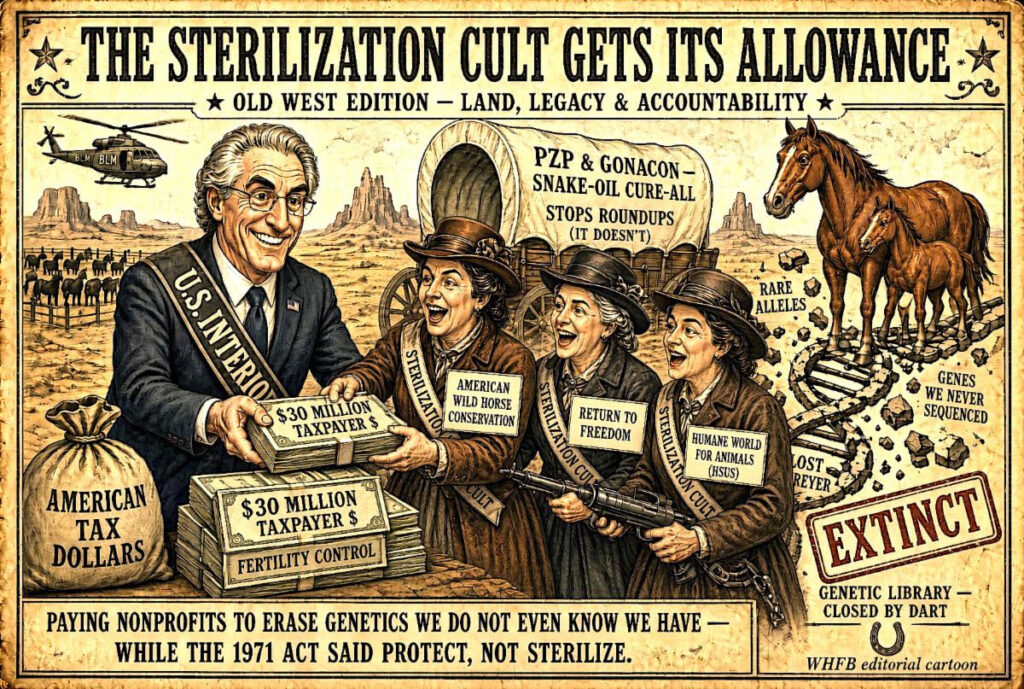
$30 million to dart and suppress the genetics of the remaining Cultural-Heritage American Wild Horses that Congress ordered protected is not “safeguarding the Spirit of the West.”
That line is Interior Secretary Doug Burgum’s. It is treating a federally protected icon like a pest — and skipping the cheaper, naturally-humane, legal alternative already on the table.
This week Secretary Doug Burgum put his name on a Bureau of Land Management announcement: $30 million to expand “fertility control” of America’s wild horses and burros. USDA will train and deploy more applicators. BLM stays the land manager. The agency still says helicopter gathers come first; vaccines are to hold numbers after the trap. FY2025 treated 921 animals (484 PZP, 99 PZP-22, 338 GonaCon). The new goal is to treat about 75 percent of mares every year once herds are cut to Appropriate Management Level. Roundups do not end.
Call it what the press packet will not: a sterilization build-out. PZP and GonaCon are immunocontraceptives. Repeated use is associated in the published record with ovarian shutdown, extended infertility, band disruption, and dart trauma. Branding the package “humane fertility control” does not repeal that literature. It also does not repeal two harder facts.
1. The 1971 Act did not authorize a pest-control program.
Public Law 92-195 is not ambiguous. Congress found wild horses “living symbols of the historic and pioneer spirit of the West,” contributing to “the diversity of life forms,” and “fast disappearing.” The policy of the United States is that they “shall be protected from capture, branding, harassment, or death” and “considered in the area where presently found, as an integral part of the natural system of the public lands.” Management is to be at the “minimal feasible level.”
A $30 million dart corps, after gathers that already warehouse tens of thousands off-range, is not minimal. It is industrial suppression of reproduction in animals the statute treats as wildlife components of the range — not livestock units to be zeroed out to AML and then chemically locked there.
The same Secretary quotes “passion” for the Spirit of the West while BLM’s own FY2024 ledger still spends the bulk of a $153 million program on holding pens, not on-range ecology. Off-range care ate about $101 million (66%) of that year. Fertility control remains the cheap political headline on top of the expensive trap-and-warehouse machine.
2. Tiny AMLs plus mass contraception violate the Bureau’s own genetics rules — and IUCN-class conservation math.
BLM’s Wild Horses and Burros Management Handbook and its genetic guidance are not activist talking points. They are the agency’s paper. Section 4.4.6.3 recommends a minimum of about 50 breeding animals — a total herd on the order of 150–200 — to keep acceptable diversity. Resource notes warn that effective population size (Ne) near 50 is only a short-term floor borrowed from domestic breeding, and that Ne in a harem-structured horse herd is often only 30–35% of head count. A census of 150 can mean Ne ≈ 50. Below that, drift and inbreeding accelerate. NAS reviewers went further: if fitness matters, Ne well above 50 is required; long-term rules of thumb in conservation genetics run toward Ne ≈ 500 (the IUCN-associated 50/500 framework). Many HMAs are held below the handbook minimum. Then contraception removes still more animals from the breeding pool.
That is how you manufacture genetic decline and call it management. You cannot “protect diversity of life forms” by systematically sterilizing the mares that carry it.
3. The alternative is not theoretical. It is WHFB.
Wild Horse Fire Brigade does not dart the West into silence. It moves family bands — from conflict allotments and from holding — into economically and ecologically appropriate wilderness, where motorized fuels crews and prescribed fire are restricted, and where horses resume the job they evolved to do: graze fine fuels.
Documented WHFB points, not slogans:
• Holding and gather machinery costs taxpayers on the order of $150 million a year. Relocating horses out of that warehouse stops the meter.
• Each horse on the right landscape consumes on the order of 5.5 tons of grass/brush fuel per year.
• Lifetime fuels-work value has been estimated near $72,000 per horse versus hand crews and burns — before counting even a sliver of avoided wildfire loss.
• California-scale fire years have run to tens or hundreds of billions in damage. A few percent reduction is not a rounding error. It is hundreds of millions to billions.
That is the opposite of a pest program. It is keystone herbivory as infrastructure.
Burgum’s $30 million trains more people to shoot syringes. It does not reopen wilderness to the horses already sitting in pens at $2–$6 per head per day. It does not restore collapsed herbivore pressure that would make glyphosate-and-dozer “restoration” less necessary after fire. It buys another year of the same loop: gather, hold, dart, gather again.
What “safeguarding” would look like if Interior meant the 1971 findings:
• Stop treating protected wildlife as a reproductive problem to be vaccinated away.
• Raise herd sizes to handbook/IUCN-class genetic floors instead of chemically freezing sub-viable AMLs.
• Pilot WHFB-scale transfers from holding into appropriate wilderness and score them on fuel load, fire behavior, soil, and taxpayer outlay — not on dart counts.
• Publish the $30 million work plan: how many mares, which HMAs, PZP vs GonaCon vs PZP-22, retreatment schedule, and the genetic Ne of each target herd after 75% of mares are taken out of foaling.
Until that happens, the honest name for this week’s announcement is not fertility control. It is a taxpayer-funded suppression program that Congress never described in 1971, that BLM’s own genetics chapter cannot justify, and that is unnecessary if the horses are put back to work where fire starts.
The Spirit of the West does not need a dart gun and syringe. It needs range.
Visit www.wildhorsefirebrigade.org for more information.