Last Updated on June 28, 2026 by adminahb
Mission
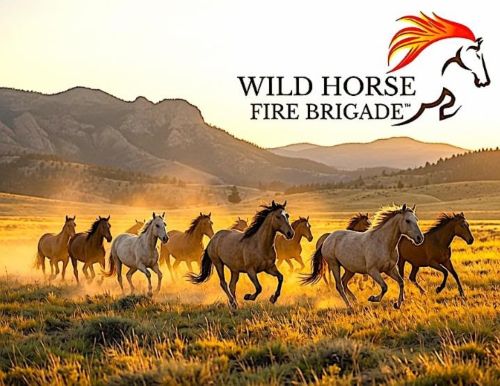
The Wild Horse Fire Brigade is a volunteer-driven 501(c)(3) nonprofit dedicated to protecting and preserving North America’s wild horses by rewilding them as native keystone herbivores into suitable wilderness areas. This restores their natural role in managing wildfire fuels through grazing while delivering genetically sustainable conservation via intact family bands in predator-balanced habitats.
The mission provides a humane, science-based alternative to mass roundups, fertility control that disrupts social structures and causes harm, prolonged holding facilities, and slaughter — advancing the protective intent of the 1971 Free-Roaming Wild Horse and Burro Act.
The WHFB Plan
This is a Plan from someone with empirical experience in forest management, wildfires, trained in science and livestock management. Here is an ABC News interview with William E. Simpson II
The WHFB Plan (Natural Wildfire Abatement and Forest Protection Plan) relocates excess wild horses from conflict areas or holding facilities as intact family bands into designated wilderness and private forest lands rich in forage and water (utilizes ‘Humane Transfer of Excess Animals Act‘). There, as keystone herbivores, they continuously graze down accumulations of annual grass and brush that build up when native herbivore populations collapse. This creates natural firebreaks, maintains fuels at lower levels year-round, reduces ignition risk and fire intensity, and restores ecological balance without mechanical clearing, chemicals, livestock competition, or heavy human intervention. These benefits have been empirically proven in real-life wildfires.
The approach is supported by peer-reviewed science demonstrating that large herbivores shape fire regimes by altering fuel quantity and distribution. Wild horses are particularly effective due to their digestive system (dispersing viable native seeds), low-impact hooves, soil fertilization, and symbiotic interactions that enhance biodiversity and tree resilience to fire. The plan is scalable across hundreds of millions of acres of private wilderness and appropriate public lands, emphasizing natural selection for genetic vigor and coexistence among nature, people, and industry.
A long-term pilot at Wild Horse Ranch with a herd of ~200 cultural-heritage horses has validated the model through immersive behavioral and ecological research. This pilot has also resulted in a highly experienced team of wild horse experts, who have uniquely owned and managed one of the largest naturally-living free-roaming herds of wild horses in America, with over 12 years of unmatched hands-on empirical experience, a critical prerequisite for any successful rewilding project.
Key WHFB Accomplishments
- Developed and operated a successful multi-year pilot program at Wild Horse Ranch demonstrating sustained fuel reduction and natural firebreak creation in wilderness settings.
- During the 2018 Klamathon Fire, herd-grazed areas provided reduced fuel loads and protective firebreaks that supported emergency response efforts and helped limit fire impacts in the landscape. Post wildfire collaborations with Rewilding Europe led to the publication of Simpson’s preliminary 5-year Study at GrazeLIFE in 2019, which then led to Spain and Portugal’s implementation of similar programs in the following years with great success.
- Through federal litigation, halted an unlawful roundup in the Pokegama Herd Management Area, protecting horses and advancing precedents for humane management.
- Conducted over a decade of intensive immersive observational research (tens of thousands of hours) on wild horse ethology, family band dynamics, and ecosystem interactions, producing new insights for natural management and rewilding.
- Humanely rewilded dozens of horses previously at risk of slaughter or indefinite holding, achieving successful family-band integration and natural habitat adaptation.
- Created more than 200 educational videos and secured national media coverage (NPR and major networks) to promote awareness of nature-based solutions.
- Started the world’s first university-level wilderness-taught wild horse ecology program with CALSTATE and taught the successful program for 3 years.
- Built a dedicated volunteer advocacy board and launched outreach to legislators, land managers, and communities to scale rewilding pilots on 100,000+ acre tracts.
- Obtained legal recognition and management authority for the cultural-heritage herd.
Stakeholder Benefits of the WHFB Plan
The plan generates powerful, interconnected benefits by addressing root causes of escalating wildfire frequency, intensity, and toxic smoke through natural fuel management.
Wild Horses
Horses gain a humane, permanent path to live wild and free in intact family bands within predator-rich wilderness. This eliminates the trauma of roundups, fertility control injuries, auctions, and slaughter while preserving cultural-heritage lineages and allowing natural selection to sustain genetic vigor.
Ecosystems, Forests, and Wildlife
Restores the missing keystone herbivore function that reduces catastrophic wildfire frequency and intensity. Continuous grazing lowers fuel loads, promotes native plant reseeding via manure, improves soil health and carbon sequestration, minimizes erosion (protecting fisheries and spawning grounds), and creates conditions for biodiversity recovery. It enhances tree fire resilience, provides a prey buffer for carnivores, and rebalances ecosystems strained by collapsed herbivore populations. Wildlife mortality from megafires (estimated 20–80 animals killed per acre burned) is substantially reduced.
Communities, Landowners, and Local Governments
Delivers a natural, year-round, low-maintenance fuel management solution for private and adjacent public lands, significantly lowering wildfire risk to homes, infrastructure, and lives. Even modest reductions in fire frequency and intensity translate into avoided property losses (thousands of homes destroyed annually nationwide) and support healthier air quality for residents.
Taxpayers, Public Health, and the Broader Public — Wildfire Costs, Deaths, and Smoke Impacts
This is where the plan’s benefits are especially profound and urgent.
Wildfire smoke currently drives an escalating human and economic crisis in the Western United States. Annual premature deaths from wildfire-specific PM2.5 and associated novel toxins are estimated at 25,000–36,300 in the West (with national excess deaths averaging ~40,000 per year from 2011–2020). Projections indicate these figures could rise toward 70,000 nationally by 2050 without intervention. For every premature death, there are typically 5–10 cases of serious long-term co-morbidities, including respiratory diseases, cardiovascular events, autoimmune disorders, and other chronic conditions affecting hundreds of thousands more people annually.
Economic costs tied to wildfire smoke in the West are estimated at $150–242 billion per year (healthcare, lost productivity, and mortality valuation), with California alone experiencing roughly $40 billion in annual smoke-related costs. Cumulative damages are already in the hundreds of billions, and without action these burdens are projected to double or more by mid-century. Additional direct wildfire losses include billions in insured and uninsured property damage and suppression costs.
By restoring natural herbivory and reducing the excessive grass and brush fuels that drive hotter, more toxic fires (and the formation of harmful intermediate- and semi-volatile organic compounds in smoke), the WHFB Plan directly mitigates these impacts. Even small percentage reductions in wildfire frequency and intensity across the landscape — achievable through scalable rewilding — yield hundreds of millions to billions of dollars in avoided annual costs while preventing thousands of premature deaths and hundreds of thousands of chronic illnesses over time.
Combined with direct taxpayer savings of over $150 million annually from reduced wild horse holding and management costs, plus an additional ~$30 million from even a 2–3% landscape-level reduction in wildfire losses, the plan delivers approximately $180 million in combined annual fiscal benefits — while addressing far larger human and economic tolls from fire and smoke. These nature-based outcomes also reduce the need for costly prescribed burns (which themselves emit millions of tons of compounds) and support long-term climate resilience through enhanced carbon sequestration and ecosystem stability.
Researchers, Educators, and Equine Professionals
Provides unique real-world data from long-term studies and supports advanced research (including planned drone and telemetry programs). It enables hands-on educational opportunities through proposed programs such as a Natural Horse Behavior Certificate.
Broader Societal and Ethical Benefits
Demonstrates that ethical, science-informed wildlife management can resolve complex challenges, honors the cultural significance of American wild horses, and fosters genuine coexistence between nature, people, and industry. By converting a persistent policy and ecological failure into a scalable win-win, the plan protects lives, saves enormous public resources, restores ecosystem function, and offers a replicable model for wildfire-prone regions worldwide.
The WHFB Plan transforms wild horses from a perceived problem into one of the most effective, humane, and cost-efficient tools available for wildfire abatement and ecological restoration — delivering life-saving, multi-billion-dollar-scale benefits while fulfilling a clear moral and legal imperative to protect these iconic animals.
Visit www.wildhorsefirebrigade.org for more information.